Pages

Showing posts with label Fairy Tales. Show all posts

Tuesday, December 30, 2014

A Red & Pleasant Land By Zak S. From Lamentations Of The Flame Princess


Zak_Smith_Red_&_Pleasant_Land

Grab It Right
HERE

I recently asked for a copy of a Red and Pleasant from James Raggi of Lamentations Of The Flame Princess after reading Tim Brananan's blog's review of the book on his blog HERE and for the life of me I've been trying to process the whole of this  book. Its part campaign setting, part art book, and part deep end launch into Zak Smith's pick up of the Alice In Wonderland books as well as legends and fairy tales surrounding the Lewis Carroll books shoved into a blender with classic Dracula and set on nightmare and the dream setting.


What's the book about? Well to be honest the back cover explanation doesn't convey half of the feel of the campaign kit/setting. It covers in broad strokes and artful descriptions a battle that has raged across 
A terrible Red King wars with an awful Queen, and together they battle into being a rigid, wrong world… and this book has everything you need to run it. (And any other place in your first, second, third, fourth or fifth edition game that might require intrigue, hidden gardens, inside-out-rooms, scheming monarchs, puzzles or beasts, liquid floors, labyrinths, growing, shrinking, dueling, broken time, Mome Raths, blasphemy, croquet, explanations for where players who missed sessions were, or the rotting arcades and parlors of a palace that was once the size of a nation.)
Zak S, game master on I Hit It With My Axe and author of the multi award-winning Vornheim: The Complete City Kit now brings the same do-it-yourself tables-and-toolkits approach and eerie magic to an entire distorted continent.

Voivodja is an old land with its own all encompassing setting and its old, rotten to the core , and damned as well as dangerous. The place is thick with vampire courts, heroes, heroines, and things they get up to all bound within a unconventional book. Many of the characters of Alice in Wonderland and Through The Looking Glass have been re imagined as ancient creatures out of European legend. Very old and very strange vampires of royalty with their own agendas and view points of events surrounding the brand new character class that shapes the events within , 'The Alice'.  'The Alice' is a new take on the 'Specialist' from The Lamentations of the Flame Princess as a heroine lightning rod for the adventure  events surrounding Voivodja. The Alice plugs into every single heroine and princess of every dream like fairy tale and pop culture fantasy that streams through the collective unconscious. 


The OSR produces tons and tons of random tables and A Red & Pleasant land has over thirty pages of them but this book implements the tables as key parts of the setting narrative guiding the PC's into the workings of the adventure setting. They range from the general encounter style ones, to one the spot adventure creation tables that happen on the fly, there are NPC generators, and more all tied neatly back into the Voivodja setting. This happens over and over again tying the PC's into the narrative of the dreamlike decayed fairy tale setting.

I've been reading reviews of A Red and Pleasant Land over and over the last few days then referencing back to the PDF. One thing that strikes me is how each person sees their own version of the setting of the Land of Unreason. This fact highlight's the phantasmagorical  nature of  Voivodja as a campaign. The factions are at each other's throats and warfare here can take the form of a game of crochet or the exploration of the setting's adventure locations. These are not simple dungeons in the conventional sense nor are they mega dungeons with their own ecologies  instead  they're almost artifacts of some old fairy tale echoing from older dreams as well as nightmares given a DYI D&D slant. 

The book is filled top to bottom with Zak Smith's artwork which set's the tone for the entire book from top to bottom marking it as an art book as well as a roleplaying campaign setting. The book is very well done in the graphic's regard. Its a brutal art book and it takes no prisoners with its dark, decadent artwork reflecting the feel of the dreamlike land of Unreason.

We're given a tour of this setting with options to look into niches,crannies, and the dark spots but there's plenty of room to get into the deepest recesses of the dream like realm. NPC's have motives and reasons as well as complex chess like takes on the state of things in the Land Of Unreason. Sometimes these goals and grudges stretch back centuries.


One thing about Voivodja, every single DM I showed this pdf in my circles of players and DM's has a different view of the setting.  Some see it as an other classic take on the Alice novels and the vampire literature. Still others have told me that its a gate way drug setting to a brand new take on using fairy tales as campaign settings. Still others have stated that this is a breath of fresh air for the Lamentations of the Flame Princess rpg system and boosts the powerful hero PC take that the game has had lurking in the backdrop since its release. A Red and Pleasant Land simply gives validation to this ideal with bells.


Voivodja is a mix of all of the above and then some. Does it break new ground? Yes and it does it with style as a campaign setting. Do I think that it will set the world on fire? Perhaps as a way to show other game companies that there is more then a few ways of creating graphic design as a gateway for presenting your game as a both an exhibit for your product ideals and as a character within the campaign setting. A Red and Pleasant Land is as much an rpg artifact as a campaign setting.
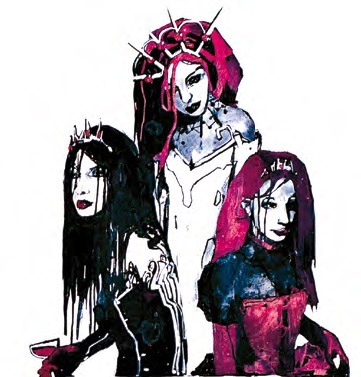

The longer I read a Red and Pleasant Land the more the setting plays and begs to be run. There are bits of horror, fairytale, and lurking spillage of a world that runs right below the mirrors and places of shadow right behind our own world. The setting has as much of the modern running through its narrative as an alternative dimension as a it is a D&D setting.
There are so many hooks lurking in the back drop of the book that it begs to be connected with the rest of the Lamentations of The Flame Princess system but it could really be used with a great variety of other retroclones as well.
There are so many ways that this book could be plugged into games as a horror setting or as a completely different take on fairy tales. The author gives the DM everything he needs to take this setting and use it as everything from tool kit to complete campaign. The book can be dipped into a bit at a time or taken as a whole and used completely. My advice is to take the PC's there for a short visit and let them kick the tires of the setting and then see where this book takes them.

There is enough conflict for several years worth of play at least here with plenty to deal with if not more.


I don't think that A Red and Pleasant Land is a perfect role playing book but I do think that its one of the best to come out for 2014. Its a good and solid hit for the Lamentations of The Flame Princess.
Do I think that you should buy this book? Yes and I'm going to purchase a physical copy as soon as possible. 


Friday, November 15, 2013

Part II Of The "Real" Sleeping Beauty' A Public Domain Resource For Your Old School Horror Campaign

File:Sleeping beauty by Edward Burne-Jones.jpg

Fairy tales are supposed be fun little stories we tell our children at bed time. Nothing could be further from the truth and 'the Disney" corporations of this world aren't stupid. They love to copyright, trademark, and stamp every single piece of the psychic landscape and our children's imagination.
They can't because Fairy and the Fey won't let them. These are wild things of chaos and dream sewn together with the collective human unconsciousness of hundreds of years of legends.
Think this hasn't anything to do with the hobby we love? Think again Mr. 
David Lance "Dave" Arneson & so did Mr. Richard Snider  knew better and so capitalized on those stories for an old school rpg that never made it.  It has however been retrocloned HERE

 Far better then me reviewed that game HERE
In the tale of The Glass Coffin the forces of Fairy are in full effect.  File:Briar Wood Buscot Park.jpg

The tale according to Wiki is a wild one and collected by the brothers Grimm.
The Glass Coffin is a German fairy tale collected by the Brothers Grimm, tale number 163.[1] Andrew Lang included it in The Green Fairy Book as The Crystal Coffin.
The Green Fairy Book available right 
According to Wiki : 
A tailor's apprentice became lost in a forest. When night came, he saw a light shining and followed it to a hut. An old man lived there and, after the tailor begged, allowed him to stay for the night. In the morning, the tailor awoke to witness a fight between a great stag and a bull. After the stag won, it bounded up to him and carried him off in its antlers. It set him down before a wall of stone and pushed him against a door in it, which then opened. Inside the door, he was told to stand on a stone, which would bring him good fortune. He did so, and it sank down into a great hall, where the voice directed him to look into a glass chest. The chest contained a beautiful maiden, who asked him to open the chest and free her, and he did so.
The maiden told him her story: She was the daughter of a rich count, and after the death of her parents, she had been raised by her brother. One day, a traveler stayed the night and used magic to get to her in the night, to ask her to marry him. She found the use of magic repellent and rejected his proposal. In revenge the magician then turned her brother into the stag, imprisoned her in the glass chest (coffin), and enchanted all the lands around them.
The tailor and the maiden emerged from the enchanted hall and found that the stag had been transformed back into her brother. The bull he had killed had been the magician. The tailor and the maiden then married.
But this is not the only tale in the Glass Coffin cycle. There is also tale of "The Young Slave" 

Once again wiki : 
Girls competed to jump over a rose bush; at last Cilia, the baron's sister, did so, but she knocked off a rose petal. To pretend she had cleared it entirely, she swallowed the petal and became pregnant. She bore a daughter, named her Lisa, and gave her to fairies to raise. The fairies gave her gifts, but one twisted her ankle and cursed Lisa to die when she was seven, because her mother, combing her hair, forgot the comb in her hair. This happened, and the lamenting mother put her in seven crystal coffins and put them in a room. Her health failed. Before she died, she gave her brother the key to the room and make him promise not to open it.
He obeyed, but he married, and one day while he hunted, his wife opened the door. Jealous of the girl's beauty, she pulled her out by her hair, which knocked out the comb and brought her back to life. The woman beat her and made her a slave, telling her husband that her aunt had sent her a slave and warned her that stern measures were necessary with this perverse slave.
The baron went to the fair and asked everyone for what they wanted. Lisa asked for a doll, a knife, and some pumice-stone, and cursed him not be able to cross a river to return if he did not. He forgot them, but the river swelled, reminding him. Lisa took them to the kitchen and told her story to the doll, and then threatened to sharpen the knife on the stone and kill herself if the doll did not answer. The doll did.
After several days of this, the baron heard this and eavesdropped. When the girl began to whet the knife, he broke into the kitchen and took it from her. Then he put Lisa in the care of a relative, where she regained her health and beauty. The baron brought her to his own home, dismissed his wife back to her relatives, and in due course married off his niece.
Enchanted lands, half fairies, weird magical dolls, curses, and resurrection spells all in one small story?  Sounds like the makings of a Gothic Fairy Tale AD&D campaign to me! File:The Council Chamber Buscot Park.jpg
Fairy Tales are not sexist either there is another variant with an enchanted prince and some very interesting circumstances. This one was told to me by a lovely Greek Ex girl friend back in college.
The Sleeping Prince according to Wiki 

A king had only his daughter, his wife having died, and had to go to war. The princess promised to stay with her nurse while he was gone. One day, an eagle came by and said she would have a dead man for a husband; it came again the next day. She told her nurse, and her nurse told her to tell the eagle to take her to him. The third day, it came, and she asked; it brought her to a palace, where a prince slept like the dead, and a paper said that whoever had pity on him must watch for three months, three weeks, three days, three hours, and three half-hours without sleeping, and then, when he sneezed, she must bless him and identify herself as the one who watched. He and the whole castle would wake, and he would marry the woman.
She watched three months, three weeks, and three days. Then she heard someone offering to hire maids. She hired one for company. The maid persuaded her to sleep, the prince sneezed, and the maid claimed him. She told him to let the princess sleep and when she woke, set to tend the geese. (The fairy tale starts to refer to the prince as the king.)
The king had to go to war. He asked the queen what she wanted, and she asked for a golden crown. He asked the goose-girl, and she asked for the millstone of patience, the hangman's rope, and the butcher's knife, and if he did not bring them, his ship would go neither backward nor forward. He forgot them, and his ship would not move; an old man asked him if he had promised anything, so he bought them. He gave his wife the crown and the other things to the goose-girl. That evening, he went down to her room. She told her story to the things, and asked them what she should do. The butcher's knife said to stab herself; the rope, to hang herself; the millstone, to have patience. She asked the rope again and went to hang herself. The king broke in and saved her. He declared she was his wife and he would hang the other on the rope. She told him only to send her away. They went to her father for his blessing.
Available right over
HERE
Suicide, enchanted items, weird fairy lands once again and we finally have the makings of some very dangerous and dark tales this time from Greece. 

 Using The Glass Coffin Cycle In Your
Old School Horror Campaigns

File:The Garden Court Buscot Park.jpg

These tales clearly illustrate the most diabolic forces of Fey magic in the hands of human magicians. The lands become enchanted and very dangerous. Objects take on a life of their own. Resurrection spells come into vague and the forces of life and themselves come into play.
These are epic tales where years, centuries, and hidden agendas of power of unseen forces reign over the lives of the humans of these worlds.
Here the social fabric is turned inside out and tailor sons become princes and marry enchanted princesses. Suicide, death, and even undeathly sleep is the norm. This isn't the world of Tolkien or many of the fictional worlds that players may be familiar with at all. These are enchanted realms where the monsters of OD&D and AD&D are equally at home. Time is bent and broken in some cases. Many of these realms are demi planes in their own right and can be used as side adventures or as part of greater cycle. The rule here is on the epic and the magical of fairy and Fey. These tales are part way between dark Arthurian legend and the realms of legend as well as beyond.
Since these tales are in the public domain be sure to bend, change, and even break the mold with them.
 More to come! 

Wednesday, November 13, 2013

Disney's Maleficent and The Real Public Domain 'Sleeping Beauty' For Your Old School Campaigns


Disney's Maleficient teaser trailer has hit the interwebs today and is causing quite a stir. Yeah there is enough CGI eye candy to shake a stick at. Looks great, sounds wonder, incredble  CGI artwork, and the trailer looks great. But you've only gotten half of the story and the story is much, much, darker then anything you'll see on screen! The real fairy land isn't owned by Disney and the "real "Sleeping Beauty is in the Public Domain. And its rifle for adapting to OD&D as well as AD&D . 
Original Source Available
Right over
HERE
According to Wiki :
"The Sleeping Beauty" (FrenchLa Belle au bois dormant "The Beauty sleeping in the Wood") by Charles Perrault or "Little Briar Rose" (GermanDornröschen) by the Brothers Grimm is a classic fairytale involving a beautiful princess, enchantment of sleep, and a handsome prince. Written as an original literary tale, it was first published by Charles Perrault in Histoires ou contes du temps passĂ©in 1697
 The basic elements of Perrault's narrative are in two parts. Some folklorists believe that they were originally separate tales, as they became afterward in the Grimms' version, and were joined together by Basile, and Perrault following him
Plot Overview of Part One 

At the christening of a king and queen's long-wished-for child, seven fairies are invited to begodmothers to the infant princess. At the banquet back at the palace, the fairies seat themselves with a golden casket containing golden jeweled utensils laid before them. However, a wicked fairy who was overlooked, having been within a certain tower for many years and thought to be either dead or enchanted, enters and is offered a seating, but not a golden casket since only seven were made. The fairies then offer their gifts of beauty, wit, grace, dance, song and music. The old fairy then places the princess under an enchantment as her gift: the princess will prick her hand on a spindle and die. One last fairy has yet to give her gift and uses it to partially reverse the wicked fairy's curse, proclaiming that the princess will instead fall into a deep sleep for 100 years and be awoken by a king's son.
The king forbids spinning on spinning-wheels or spindles, or the possession of one, throughout the kingdom, upon pain of death. When at the end of the fifteen or sixteen years, the king and queen are one day away on pleasure bent, the princess wanders through the palace rooms going up and down and then chances upon an old woman who is spinning with her distaff in the garret of a tower and had not heard of the king's decree against spinning wheels. The princess asks to try the unfamiliar task and the inevitable happens: the curse is fulfilled. The old woman cries for help and attempts are made to revive the princess, but to no avail. The king attributes this to fate and has the princess carried to the finest room in the palace and placed upon a bed of gold-and-silver-embroidered fabric. The good fairy who altered the evil prophecy is summoned by a dwarf wearing seven-league boots and returns in a chariot of fire drawn by dragons. Having great powers of foresight, the good fairy sees that the princess will be distressed to find herself alone and so puts everyone in the castle to sleep. The king and queen kiss their daughter goodbye and depart, proclaiming the entrance to be forbidden. The good fairy's magic also summons a forest of trees, brambles and thorns that spring up around the castle, shielding it from the outside world and preventing anyone from disturbing the princess.
A hundred years pass and a prince from another family spies the hidden castle during a hunting expedition. His attendants tell him differing stories regarding the happenings in the castle until an old man recounts his father's words: within the castle lies a beautiful princess who is doomed to sleep for a hundred years, whereupon a king's son is to come and awaken her. The prince then braves the tall trees, brambles and thorns which part at his approach, and enters the castle. He passes the sleeping castle folk and comes across the chamber where the princess lies asleep on the bed. Trembling at the radiant beauty before him, he falls on his knees before her. The enchantment comes to an end and the princess awakens and converses with the prince for a long time. Meanwhile, the rest of the castle awakes and go about their business. The prince and princess head over to the hall of mirrors to dine and are later married by the chaplain in the castle chapel.

Part II 
File:W.E.F. Britten - The Early Poems of Alfred, Lord Tennyson - Sleeping Beauty.jpg

 "Little Briar Rose" (GermanDornröschen) by the Brothers Grimm
Available right over
HERE


Plot Overview Part II 
According to Wiki :
After having been secretly wed by the reawakened Royal almoner, the Prince continued to visit the Princess, who bore him two children, L'Aurore (Dawn) and Le Jour (Day), which he kept secret from his step-mother, who was of an ogre lineage. Once he had ascended the throne, he brought his wife and the talabutte ("Count of the Mount").
The Ogress Queen Mother sent the young Queen and the children to a house secluded in the woods, and directed her cook there to prepare the boy for her dinner, with a sauce Robert. The humane cook substituted a lamb, which satisfied the Queen Mother, who then demanded the girl, but was satisfied with a young goat prepared in the same excellent sauce. When the Ogress demanded that he serve up the young Queen, the latter offered her throat to be slit, so that she might join the children she imagined were dead. There was a tearful secret reunion in the cook's little house, while the Queen Mother was satisfied with a hind prepared with sauce Robert. Soon she discovered the trick and prepared a tub in the courtyard filled with vipers and other noxious creatures. The King returned in the nick of time and the Ogress, being discovered, threw herself into the pit she had prepared and was fully consumed, and everyone else lived happily ever after.
Older Variations of the Myth of The Sleeping Beauty 
File:Ring34.jpg
According to Wiki:
Perrault transformed the tone of Basile's "Sole, Luna, e Talia". Beside differences in tone, the most notable differences in the plot is that, in Basile's version, the sleep did not stem from a curse, but was prophesied; that the king did not wake Talia from the sleep with a kiss, but prayed to the gods to wake her,[3] when the gods visited he she gave birth to two children, one sucked on her finger, drawing out the piece of flax that had put her to sleep, which woke her; and that the woman who resented her and tried to eat her and her children was not the king's mother but his jealous wife. The mother-in-law's jealousy is less motivated, although common in fairy tales.
In Giambattista Basile's version of Sleeping Beauty, the sleeping beauty was named Talia. When checking out her horoscope, her father had found out that Talia would be in danger from a splinter of flax. This splinter was the cause of Talia's long deep sleep. Unlike the version most of us know from Sleeping Beauty, Basile's version consisted of a more gruesome plot. After Talia (sleeping beauty) died/fell into the deep sleep, she was seated on a velvet throne and her father, to forget his misery of her death, closed the doors and abandoned the house forever. One day, while a king was walking by, one of his falcons flew into the house. The king knocked hoping to be let in by someone but since no one answered, he decided to climb up the ladder he had brought with him and go inside the house. There he saw Talia. He called on her but she was unconscious. Instead of finding out what's wrong or even being worried about this, he carried her to bed and raped her while she was unconscious. Then he just left her in the bed and went back to his kingdom. Even though Talia was unconscious, she gave birth to twins. One of whom kept sucking her fingers. Talia woke up because the twin had sucked out the flax that was stuck deep in Talia's finger. When she had woken up, she saw that she was a mother. She did not know what had happened to her. One day, the king had decided he wanted to go see Talia again and went back to the palace to find her awake and a mother to his twins. He caught her up to who he was, what had happened, and they ended up bonding. After a few days, the king promised her that he will return to take her to his kingdom and went back to his realm. The King's wife kept hearing "Talia, Sun and Moon" coming out of her husband's mouth in his sleep so she bribed the king's secretary and also scared him to tell her what was going on. After the queen learned the truth, she pretended she was the King and wrote Talia asking her to send the twins because he wanted to see them. Talia sent her kids to the "king" and the queen told the cook to kill the kids and make dishes out of them. She had wanted to feed the king his children. The cook instead of doing what the queen had told him, took the kids to his wife and hid them. He then cooked two lambs and served it as it was the kids. Every time the king mentioned how good the food was, the queen replied "Eat, eat, you are eating of your own". Then queen later invited Talia to the kingdom and was going to burn her alive, but the king appeared and found out what was going on about his children and Talia. He then ordered that his wife be burned and not Talia. He also burned those who betrayed him. Since the cook actually did not obey the queen, the king thanked the cook for saving his children by giving him rewards. The story ends by the king marrying Talia and living happily ever after.[4]
There are earlier elements that contributed to the tale, in the medieval courtly romance Perceforest (published in 1528), in which a princess named Zellandine falls in love with a man named Troylus. Her father sends him to perform tasks to prove himself worthy of her, and while he is gone, Zellandine falls into an enchanted sleep. Troylus finds her and impregnates her in her sleep; when their child is born, he draws from her finger the flax that caused her sleep. She realizes from the ring he left her that the father was Troylus; he returns after his adventures to marry her.[5]
Earlier influences come from the story of the sleeping Brynhild in the Volsunga saga and the tribulations of saintly female martyrs in early Christian hagiography conventions. It was, in fact, the existence of Brynhild that persuaded the Brothers Grimm to include the story in later editions of their work rather than eliminate it, as they did to other works they deemed to be purely French, stemming from Perrault's work.
The second half, in which the princess and her children are almost put to death, but hidden instead, may have been influenced by Genevieve of Brabant.
File:Sleeping beauty by Edward Burne-Jones.jpg
This fairy tale is classified as Aarne-Thompson type 410.[7]
The princess's name has been unstable. In Sun, Moon, and Talia, she is named Talia ("Sun" and "Moon" being her twin children). Perrault removed this, leaving her anonymous, although naming her daughter "L'Aurore". The Brothers Grimm named her "Briar Rose" in their 1812 collection.[8] This transfer was taken up by Disney in the film, which also called her Aurora.[9] John Stejean named her "Rosebud" in TeleStory Presents.
The Brothers Grimm included a variant, Little Briar Rose, in their collection (1812).[8] It truncates the story as Perrault and Basile told it to the ending now generally known: the arrival of the prince concludes the tale.[10] Some translations of the Grimm tale give the princess the name Rosamond. The brothers considered rejecting the story on the grounds that it was derived from Perrault's version, but the presence of the Brynhild tale convinced them to include it as an authentically German tale. Still, it is the only known German variant of the tale, and the influence of Perrault is almost certain.[11]
The Brothers Grimm also included, in the first edition of their tales, a fragmentary fairy tale, The Evil Mother-in-Law. This began with the heroine married and the mother of two children, as in the second part of Perrault's tale, and her mother-in-law attempted to eat first the children and then the heroine. Unlike Perrault's version, the heroine herself suggested an animal be substituted in the dish, and the fragment ends with the heroine's worry that she can not keep her children from crying, and so from coming to the attention of the mother-in-law. Like many German tales showing French influence, it appeared in no subsequent edition.[12]
Italo Calvino included a variant in Italian Folktales. The cause of her sleep is an ill-advised wish by her mother: she would not care if her daughter died of pricking her finger at fifteen, if only she had a daughter. As in Pentamerone, she wakes after the prince rapes her in her sleep, and her children are born and one sucks on her finger, pulling out the prick that had put her to sleep. He preserves that the woman who tries to kill the children is the king's mother, not his wife, but adds that she does not want to eat them herself but serves them to the king.[13] His version came from Calabria, but he noted that all Italian versions closely followed Basile's.[14]
Besides Sun, Moon, and Talia, Basile included another variant of this Aarne-Thompson type, The Young Slave. The Grimms also included a second, more distantly related one, The Glass Coffin.[7]
Joseph Jacobs noted the figure of the Sleeping Beauty was in common between this tale and the Gypsy tale The King of England and his Three Sons, in his More English Fairy Tales.[15]
The hostility of the king's mother to his new bride is repeated in the fairy tale The Six Swans,[16] and also features The Twelve Wild Ducks, where she is modified to be the king's stepmother, but these tales omit the cannibalism.

Using Sleeping Beauty In Your OSR Game 
File:La Belle au Bois Dormant - Sixth of six engravings by Gustave Doré.jpg

Enchanted fairylands, cannibalism, weird curses, and strange events that straddle reality as we know it. Sleeping Beauty the fairy tale has all of the elements of a horrifying OD&D or AD&D game in the making. All of the themes are easily convertible to your favorite old school game because they're already written into the system. 
The themes of the tales have always seemed like they'd make a kick ass D&D adventure or campagin all the way back in college when I began to look into them to convert them to one of the White Wolf games. What I found is that these tales are more readily converted into a D&D style adventure.
The lands of enchantment, the princesses, the orgesses and more more make this stuff classic fodder for a game of horror or high fantasy adventure. There have been classic modern retellings of the tales.
Once again wiki : 
There is a huge amount of room for a DM to come into these tales with adventurers helping or hindering the plot and their interaction with the weird fairyland aspect of sleeping beauty. Even though this is a fairy tale there is much to do with these tales. Adventures can take place within or around the events of both tales. The fact that many players are very unfamiliar with the niceties of these tales enables a DM to weave the mythology of snow white into the background of their own campaign.
 Much of the action of Sleeping Beauty can take place in a fairy realm or demi plane so as not to impact or to convey the weird timelessness of the setting. 
Suddenly, Elves, Dwarves, and many other Demi human races don't seem out of place at all among the the landscape of these fairy tales. They might also be used as bridge gaps into places like HP Lovecraft's Dreamlands or the other classic fairytales of Grim and those of an older variety. Osric, Swords and Wizardry, and the works of Jack Shear can easily simulate the ins and outs of this timeless, classic, and very deadly tale that is the Sleeping Beauty Saga.

Finally  in 1842 Day Dream by Lord Alfred Tennyson was written about Sleeping Beauty 

The Day-Dream (1842)[edit]

  • The bodies and the bones of those
    That strove in other days to pass,
    Are wither'd in the thorny close,
    Or scatter'd blanching on the grass.
    He gazes on the silent dead:
    "They perish'd in their daring deeds."
    This proverb flashes thro' his head,
    "The many fail: the one succeeds."
    • The Arrival, st. 2.
  • And on her lover's arm she leant,
    And round her waist she felt it fold,
    And far across the hills they went
    In that new world which is the old:
    Across the hills, and far away
    Beyond their utmost purple rim,
    And deep into the dying day
    The happy princess follow'd him.
    • The Departure, st. 1.
  • O eyes long laid in happy sleep!
    O happy sleep, that lightly fled!
    O happy kiss, that woke thy sleep!
    O love, thy kiss would wake the dead!
    • The Departure, st. 3.
  • And o'er the hills, and far away
    Beyond their utmost purple rim,
    Beyond the night, across the day,
    Thro' all the world she follow'd him.
    • The Departure, st. 4.
  • So, Lady Flora, take my lay,
    And if you find no moral there,
    Go, look in any glass and say,
    What moral is in being fair.
    Oh, to what uses shall we put
    The wildweed-flower that simply blows?
    And is there any moral shut
    Within the bosom of the rose?
    • Moral, st. 1.