Pages

Saturday, February 8, 2014

Commentary And Review On The Free Old School Pulp Novel The Metal Monster By Abraham Merritt


Download It Right Over 

This is one of my all time favorite A.Merritt tales, we have the return of Dr.Goodwin from the Moon pool, a ton of weird technology and a really solid tale of pulptastic goodness!
The fact is that this wonderful novella has a ton of possibilities. 
Metal monster sharp.jpg

According to wiki :

The Metal Monster is an Abraham Merritt fantasy novel. It was first serialized in Argosy All-Story Weekly in 1920 and features the return of Dr. Goodwin who first appeared in The Moon Pool.The epic adventure starts with a foreword where Merritt is assigned the duty to relay Dr. Walter T. Goodwin's incredible tale of his encounter in the Trans-Himalayan mountains to the world, to let everyone know the terrible fate Goodwin's group barely escaped and the possibility of other such monsters out there.
I know I'm not the only blogger whose covered this classic The Land of Nod covered it back in 2012 right over HERE
Dr. Goodwin is on a botanical expedition in the Himalayas. There he meets Dick Drake, the son of one of his old science acquaintances. They are witnesses of a strange aurora-like effect, but seemingly a deliberate one. As they go out to investigate, they meet Goodwin's old friends Martin and Ruth Ventnor, brother and sister scientists. The two are besieged by Persians as Darius III led when Alexander of Macedon conquered them more than two thousand years ago.
The group is saved by a magnificent woman they get to know as Norhala. She commands the power of lightning and controls strange metal animate Things, living, metallic, geometric forms; an entire city of sentient cubes, globes and tetrahedrons, capable of joining together and forming colossal shapes, and wielding death rays and other armaments of destruction.
They are led to a hidden valley occupied by what they name "The Metal Monster", a strange metal city occupied by the metal animate Things Norhala commands. This city is governed by what they call the Metal Emperor, assisted by the Keeper of the Cones.
Ruth is slowly being converted by Norhala to become like her; her little sister. Martin, her brother, tries shooting the Metal Emperor, who retaliates with a ray blast, putting Martin in a comatose state.
Closed in between the Metal Monster and the Persians, it falls to Goodwin and Drake to find a way to escape their predicament.
There are three versions of the story as well..
Three versions of the story exist.
The second version is named "The Metal Emperor", appearing in 1927 in Hugo Gernsback's Science and Invention magazine. It is an abridged version of the first story, with the leading character's name changed to Louis Thorton.
Using The Metal Monster For Your Old School Game 

Alright I realize that this isn't a sword and sorcery novel but the fact is that its one of those books that really stays with you and gets under your skin. Whist I was reading this one being sick I couldn't help but think of the possibilities of adding the metallic entities of this novel to a game like Astonishing Swordsmen and Sorcerers of Hyperborea.
The living technology would be perfect for a party of adventurers to encounter. And the scientist priestess in the novel makes a perfect template for an NPC priestess ruling from some distant and forgotten corner of that world.
A word of advice though, read the Moon Pool before proceeding into the Metal Monster. Some of the situations and characters will make far more sense.
This is really how I pictured the lost technology and artifacts of Hyperborea. Weird, strange and incredibly dangerous.
I can also see this novel as a bridge gap between a modern campaign and a lost world adventure in which the metal monster entities are awoken. This might even be used for a Mutant Future game adventure as well.
I can see some of the smaller entities being sold in some little forgotten out of the way market only to spring to life and take out a region as their big brothers are called in!
 All in all this is one of my favorite Merritt books. Its well written, tells a hell of a yarn, and gives a DM incredible fodder for their games 

Thursday, February 6, 2014

Five Old School Saturday Sword and Sorcery Cartoons As Well As Free Retroclone Material For Inspiration For Your Old School Sword And Sorcery Campaigns

This is a fast list off the top of my head of some of the influences that have appeared in my games over the years. 
This is a weird mix of stuff with some high science fiction style technology mixed into the background. 

Skeleton Warriors from CBS 1994 


Pirates of Dark Water 1991 


Conan The Adventurer 1992 -1993 


Herculoids 1966 to 1967 


Thundarr The Barbarian 1980


Most of these are in reruns now or on DVD. The Thundarr Material is available from the Savage After World right over HERE. 
The Herculoids AD&D files are right over HERE
The Pirates of Dark Water RPG system was profiled on The Epic Fail blog back in 2011 and has a download of the game available minus artwork and such. This thing is very close to AD&D and well you can see it right HERE 
 For Conan The Adventurer I'd say that Jason Vey's Conan material is perfectly suited to this cartoon. I'm taking away from Mr.Vey's efforts at all. I think that it emulates the look and feel of the cartoon in a much more serious tone. Available right over HERE
 Finally Arduin or Astonishing Swordsmen and Sorcerers of Hyperborea would easily work for 'Skeleton Warriors'. Simply make the heroes demi liches add in the dexterity and off you go. As always your mileage may vary considerably. 

Review and Commentary on Famous Fantastic Mysteries Issues Six And Nine For Free Download For Your Old School Sword and Sorcery Campaigns


Download It Right Over 


These two volumes contain a metric ton of free public domain science fantasy material that can easily be adapted to any number of sword and sorcery campaigns.
Go take a look this scan includes issues nine and six. Nine is first and has a ton of stories in the old school pulp tradition. Six is the issue with the 'Purple Sapphire' by John Taine.
Much of the material of Famous Fantastic Mysteries is simply neglected and forgotten by modern audiences giving a DM yet another resource to exploit for his adventurers in a weird sword and sorcery background for a campaign. 
Who was John Taine?

Eric Temple Bell (February 7, 1883 – December 21, 1960) was a mathematician and science fiction author born in Scotland who lived in the U.S. for most of his life. He published his non-fiction under his given name and his fiction as John Taine.
Wiki has this to say about Eric Temple Bell : In the early 1920s, Bell wrote several long poems. He also wrote several science fiction novels, which independently invented some of the earliest devices and ideas of science fiction.[3] Only The Purple Sapphire was published at the time, under the pseudonym John Taine; this was before Hugo Gernsback and the genre publication of science fiction. His novels were published later, both in book form and serialized in the magazines. Basil Davenport, writing in The New York Times, described "Taine" as "one of the first real scientists to write science-fiction [who] did much to bring it out of the interplanetary cops-and-robbers stage." Davenport concluded, however, that "[Taine] is sadly lacking as a novelist, in style and especially in characterization."

The reason that he is sadly lacking in characterization is because he's a pure pulp writer and science fiction journeyman. This guy was one of the first in the field before Hugo Gernsback. 

The Purple Sapphire 


 Because of its pulp themes, lost peoples, weird atmomosphere, strange events, and solid story line.I think it might make a great bridge piece for a sword and sorcery old school adventure.  
The events could be easily brought over to AS&SH as a high level adventure with the party creating the background for the story. The PC's could easily play a central part to the mysterious events surrounding the novel. 
All in all this is a great jump off point to a campaign that could span the ages and beyond. 
There is certainly enough room to add any other elements as the DM sees fit without disturbing the story in the slightest. 
DM's should consider the material and carefully read it over before committing to more of this style of adventure to make sure its right for his group of players. 


Why Famous Fantastic Mysteries Still Matters

The Famous Fantastic Mysteries method was very simple and yet elegant. Reprint classic pulp stories, with incredible artwork and deliver the goods time after time.
 According To Wiki Here's why it worked :
"By the early decades of the 20th century, science fiction (sf) stories were frequently seen in popular magazines.[1] The Munsey Company, a major pulp magazine publisher, printed a great deal of science fiction in these years,[1] but it was not until 1926 thatAmazing Stories, the first pulp magazine specializing in science fiction appeared.[2] Munsey continued to print sf in Argosy during the 1930s, including stories such as Murray Leinster's The War of the Purple Gas and Arthur Leo Zagat's "Tomorrow", though they owned no magazines that specialized in science fiction.[3] By the end of the 1930s science fiction was a growing market,[2] with several new sf magazines launched in 1939.[4] That year Munsey took advantage of science fiction's growing popularity by launching Famous Fantastic Mysteries as a vehicle for reprinting the most popular fantasy and sf stories from the Munsey magazines.[5]
The first issue was dated September/October 1939, and was edited by Mary Gnaedinger. The magazine immediately became successful and went to a monthly schedule starting in November 1939. Demand for reprints of old favorites was so strong that Munsey decided to launch an additional magazine, Fantastic Novels, in July 1940.[5] The two magazines were placed on alternating bimonthly schedules,[2] but when Fantastic Novels ceased publication in early 1941 Famous Fantastic Mysteries remained bimonthly until June 1942.[6] Munsey sold Famous Fantastic Mysteries to Popular Publications, a major pulp publisher, at the end of 1942; it appears to have been a sudden decision, since the editorial in the December 1942 issue discusses a planned February issue that never materialized, and mentions forthcoming reprints that did not appear. The first issue from Popular appeared in March 1943, and only two more issues appeared that year; the September 1943 issue marked the beginning of a regular quarterly schedule. It returned to a bimonthly schedule in 1946 which it maintained with only slight deviations until the end of its run.

Munsey's plan for the magazines was laid out in a note that appeared in the first four issues: "This magazine is the answer to thousands of requests we have received over a period of years, demanding a second look at famous fantasies which, since their original publication, have become accepted classics. Our choice has been dictated by your requests and our firm belief that these are the aces of imaginative fiction."[3] The first issue included Ray Cummings' "The Girl in the Golden Atom" and A. Merritt's "The Moon Pool", both popular stories by well-known authors.[5] Merritt's sequel, "The Conquest of the Moon Pool", began serialization in the next issue, with illustrations by Virgil Finlay. Finlay did many illustrations for Famous Fantastic Mysteries over its lifetime, and became one of its most popular artists.Frank R. Paul began illustrating for the magazine with the third issue; he was not as capable an artist as Finlay but was very popular with the readers.[5] The first five covers were simply tables of contents, but with the sixth issue, dated March 1940, pictorial covers began, with Finlay the artist for that first cover.[3] Three early covers in 1940 were painted by Paul, but thereafter almost every cover was painted by either Finlay, Lawrence Stevens, or his son, Peter Stevens, including every single issue from February 1941 through April 1950.[8][9][10][11] The high quality of the artwork helped make the magazine one of the most popular of its day,[12] and sf historian Thomas Clareson has suggested that it was Finlay's work in Famous Fantastic Mysteries and Fantastic Novels that made his reputation.[3]
The decision to launch Fantastic Novels was taken partly because there were a great many book-length works that readers wanted to see reprinted."
These magazines shouldn't be over looked as both inspiration and solid grounding for adventures. They could be used as part of a joint long term campaign for a pulp style retroclone adventure. Because they're public domain much of the material has yet to come into the providence of  sword and sorcery gamers and DM's! 

Tuesday, February 4, 2014

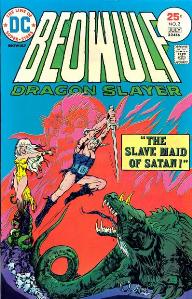
Beowulf The Dragon Slayer (DC Comics) For Your Old School Sword And Sorcery Campaign

BeowulfDCU0.jpg
 You can find this issue right
HERE
Back in 1975 Beowolf The Dragon Slayer debuted and it was a part of the weird DC sword and sorcery vibe that swept the comics back then. It was one part heavy metal concept comic, three parts sword and sorcery, eighty nine percent LSD trip into an OD&D high octane fueled trip. 
The character debuted in Beowulf: Dragon Slayer #1 (May 1975), and was created by Michael Uslan and Ricardo Villamonte.


The World Of Beuwolf The Dragon Slayer! 


 Wiki has a decent break down of Beowulf The Dragon Slayer : 

Under instructions from a being known as "The Shaper", Beowulf travels to Castle Hrothgar in Daneland, to fight the monster Grendel. On the way there Beowulf and his men take a detour into the Underworld where they rescue Nan-zee, a Swedish scylfingwarrior from the Demons who have been controlling her. Beowulf, Nan-Zee, and his companions Wiglaf and Hondscio continue onwards to Castle Hrothgar, but are again detoured, ending up in a bog where they battle Swamp Men. Meanwhile, for some reason Grendel and his mother reveal to the reader that they are descendants of Cain. Somehow, Beowulf and friends fall through a dimensional gateway beneath a patch ofquicksand into a fiery underworld they refer to as Hell.[1][2]
At a later point in the series Beowulf discovers that the only way to slay Grendel is with the nectar of the Zumak Fruit. Along the way he encounters Dracula, a mysterious Lost Tribe of Israel, Ulysses accompanied by a troop of anonymous GreekWarriors, Egyptian/Sumerian Space aliens straight out of Chariots of the Gods, and the lost city of Atlantis.[3][4][5]
In the final issue of the series Beowulf and Nan-Zee travel from Atlantis to Crete, where they finally get their hands on some Zumak fruit in the labyrinth of King Minos where Beowulf fights a Minotaur which is being controlled by Satan. Because Satan has made Dracula his heir over Grendel, Grendel kills Satan by plunging a stalactite into his back. The Minotaur dies, and Beowulf eats some Zumak fruit; the fruit grants him supernatural strength on par with Grendel. Beowulf and Nan-Zee then make their way back to Daneland in order to slay Grendel who has taken Satan's place as king of the underworld.


The Incredible Covers of Issues 1-6


This series went off the rails right around issue it goes into science fiction, Faust like horror, a huge chunk of Dante style Hell, and then some Greek myth.  Words utterly fail to capture the outrageous and weirdness  of the series.
Back in 2008 DC decided to resurrect the character for an appearance in Wonder woman along with Stalker, Claw The Unconquered, and more.
According to wiki:
 Beowulf's first appearance in over thirty years occurs in Wonder Woman #20 (July 2008), where Wonder Woman and Stalker recruit him and Claw the Unconquered for a mission to slay the Demon Lord Dgrth

 Recently I checked out the new 53 series from DC. Which the hero has now been revamped into a post apocalyptic hero. 
Beowulf is featured in a backup story in the ongoing series Sword of Sorcery beginning in September 2012. The story is written by Tony Bedard. In this version Beowulf lives in a post-apocalyptic future where the society has reverted to ancient times. Created as a super-soldier he kills an entire group of warriors sent to find him, but spares a young kid called Wigstaf who explains to be there with a message from King Hrothgar, begging Beowulf to come north and slay the monster Grendel that plagues his mead hall nightly. Beowulf is uninterested until is told that the King is a great general.[8] Upon confronting the creature Wigstaf and Beowulf discover the latter to be his brother and that both are created by Basilisk leader Regulus who had seen the threat of metahumans and aliens growing on earth, and schemed to empower average humans
I don't know but the material really seemed to lack the punch that the earlier 1970's series had. 

Gone were the encounters with  Dracula, the  mysterious Lost Tribe of Israel, and of course Ulysses accompanied by a troop of anonymous Greek Warriors, Sumerian Space aliens straight out of Chariots of the Gods, and the lost city of Atlantis.
Beowulf only lasted six issues and is now only fondly remembered by those who experienced some of DC's Sword and Sorcery comics. 
If you want to sample a story. There's one right over HERE